My kids came home from church service this afternoon. As is my usual, I asked them what the pastor spoke about. They mentioned he taught on the parable of the tares and the wheat.
What is usually my practice, is that I study up on the pastor's viewpoint and either confirm it or contend with it.
As is typically taught, the pastor taught that the tares represent people who don't follow God, while the wheat are people who do follow God. This is from the gospel of Matthew in chapter 13.
Though his is an interesting analogy, his conclusion is not what that passage is about.
I'll explain why.
Just before the parable about the tares and the wheat is the parable about the sower and the seed. In that parable, the seed, is(are) the word(words) of God sowed into a person's heart.
The next parable, the one of the pastor's focus, is another way of considering the prior parable.
Try to think of it like this. Jesus first identified the types of soil a farmer might have in the "sower and the seed" parable. Now that he established that, the next parable zoomed in on what kinds of seeds were sown into that good ground.
The parable starts out that the farmer took the good seeds from the prior parable, and he sowed those good seeds into the good ground he had prepared.
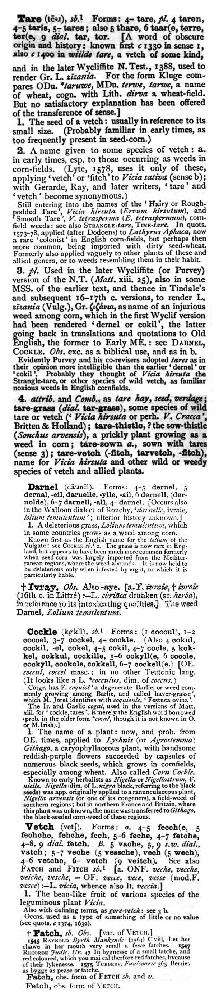
However, in times when the farmer was, well, a bit less protective of what landed in his soil, a man, an enemy, planted "tares". I attached an etymological study of sorts for you to see what a "tare" might have been.
In England, the present-day "Corncockle (Corn Cockle, Common Corncockle) (Bearded Cockle Corn)" with the Latin Name of "Agrostemma githago" or "Githago segetum" from the family of "Caryophyllaceae" is what the English translations refer to.
Get this. Ready?
All parts of the plant are toxic. Though it's not lethal, if ingested, get this ... "act as an appetite suppressant and also cause haemoglobin degeneration".
This means a person can lose an appetite to eat as well as have a degeneration of haemoglobin, which, among other purposes, "is a protein in red blood cells that carries oxygen from the lungs to the rest of the body and helps transport carbon dioxide back to the lungs. It contains iron, which allows it to bind oxygen molecules effectively."
So this toxic plant grows right along with a healthy plant that attributes to health.
Another aspect of England's "tare (darnel, cockelcorn) is that it is also called "false wheat" because it looks like wheat. It's not until it matures that it looks different.
What is my point then? A non-believing person can look and appear like a believing person, so what gives?
What gives is God loves everyone, and he hasn't created anyone for the purpose of to be destroyed and cast into the fire (Hell).
The parable before the "tares and the wheat" was the "sower and the seed". Both parables are about God's words that he speaks into the soil you prepare for him.
The "tares and the wheat" parable then is about a farmer taking good seed, planting it into good soil, but then a man plants tares, which are toxic.
The point here is that we can allow mankind to speak into our hearts. They might be well meaning, and those words my just be perceived by you the farmer as being from God. You won't be able to tell until the growth of those words in your life come to be harvested.
God already knows mankind is sowing his own purposes into your heart with words, but, in the end, God will separate that harvest from his harvest he has in you.
I love this parable because so many people, myself included, worry over having the best garden ever for our Savior, while the Lord knows we often can't tell the difference between man's purpose in our lives and God's.
Instead of worrying about uprooting one purpose in order to purify the other, God says to let them grow together because, at the harvest time, he's not worried about it. He expects no person's garden to be perfect, which means for us to focus on still being good ground because it is what grows good fruit for the good harvest.
None of are perfect.
God knows that.
He's not worried about it. Neither should any of us be worried about it either. He's got it all figured out. :)
I think of people who are steeped into beliefs which are believed to be straight from God, while, in fact, they are not.
There are a lot of good-hearted people living their lives to where they think God is honored. Their heart is good, but what they've allowed into it from mankind isn't always good. Still, God knows this happens, lets it happen, and doesn't make it a sticking point of his love for you. <3
He's got you! :D
Check out this link for more information on the Cocklecorn plant:
https://www.thetortoisetable.org.uk/plant-database/viewplants/?plant=532
(Also preserved on the WaybackMachine @ archive.org: https://web.archive.org/web/20170707065748/https://www.thetortoisetable.org.uk/plant-database/viewplants/?plant=532)
What is usually my practice, is that I study up on the pastor's viewpoint and either confirm it or contend with it.
As is typically taught, the pastor taught that the tares represent people who don't follow God, while the wheat are people who do follow God. This is from the gospel of Matthew in chapter 13.
Though his is an interesting analogy, his conclusion is not what that passage is about.
I'll explain why.
Just before the parable about the tares and the wheat is the parable about the sower and the seed. In that parable, the seed, is(are) the word(words) of God sowed into a person's heart.
The next parable, the one of the pastor's focus, is another way of considering the prior parable.
Try to think of it like this. Jesus first identified the types of soil a farmer might have in the "sower and the seed" parable. Now that he established that, the next parable zoomed in on what kinds of seeds were sown into that good ground.
The parable starts out that the farmer took the good seeds from the prior parable, and he sowed those good seeds into the good ground he had prepared.
However, in times when the farmer was, well, a bit less protective of what landed in his soil, a man, an enemy, planted "tares". I attached an etymological study of sorts for you to see what a "tare" might have been.
In England, the present-day "Corncockle (Corn Cockle, Common Corncockle) (Bearded Cockle Corn)" with the Latin Name of "Agrostemma githago" or "Githago segetum" from the family of "Caryophyllaceae" is what the English translations refer to.
Get this. Ready?
All parts of the plant are toxic. Though it's not lethal, if ingested, get this ... "act as an appetite suppressant and also cause haemoglobin degeneration".
This means a person can lose an appetite to eat as well as have a degeneration of haemoglobin, which, among other purposes, "is a protein in red blood cells that carries oxygen from the lungs to the rest of the body and helps transport carbon dioxide back to the lungs. It contains iron, which allows it to bind oxygen molecules effectively."
So this toxic plant grows right along with a healthy plant that attributes to health.
Another aspect of England's "tare (darnel, cockelcorn) is that it is also called "false wheat" because it looks like wheat. It's not until it matures that it looks different.
What is my point then? A non-believing person can look and appear like a believing person, so what gives?
What gives is God loves everyone, and he hasn't created anyone for the purpose of to be destroyed and cast into the fire (Hell).
The parable before the "tares and the wheat" was the "sower and the seed". Both parables are about God's words that he speaks into the soil you prepare for him.
The "tares and the wheat" parable then is about a farmer taking good seed, planting it into good soil, but then a man plants tares, which are toxic.
The point here is that we can allow mankind to speak into our hearts. They might be well meaning, and those words my just be perceived by you the farmer as being from God. You won't be able to tell until the growth of those words in your life come to be harvested.
God already knows mankind is sowing his own purposes into your heart with words, but, in the end, God will separate that harvest from his harvest he has in you.
I love this parable because so many people, myself included, worry over having the best garden ever for our Savior, while the Lord knows we often can't tell the difference between man's purpose in our lives and God's.
Instead of worrying about uprooting one purpose in order to purify the other, God says to let them grow together because, at the harvest time, he's not worried about it. He expects no person's garden to be perfect, which means for us to focus on still being good ground because it is what grows good fruit for the good harvest.
None of are perfect.
God knows that.
He's not worried about it. Neither should any of us be worried about it either. He's got it all figured out. :)
I think of people who are steeped into beliefs which are believed to be straight from God, while, in fact, they are not.
There are a lot of good-hearted people living their lives to where they think God is honored. Their heart is good, but what they've allowed into it from mankind isn't always good. Still, God knows this happens, lets it happen, and doesn't make it a sticking point of his love for you. <3
He's got you! :D
Check out this link for more information on the Cocklecorn plant:
https://www.thetortoisetable.org.uk/plant-database/viewplants/?plant=532
(Also preserved on the WaybackMachine @ archive.org: https://web.archive.org/web/20170707065748/https://www.thetortoisetable.org.uk/plant-database/viewplants/?plant=532)
Definition/Etymology of "Tare"